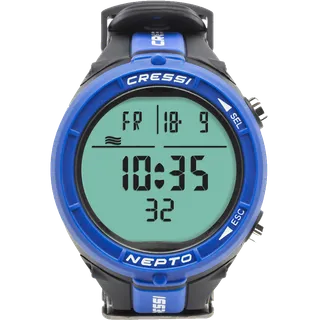
The Nepto is Cressi’s dedicated freediving computer, sharing its compact watch case with the scuba-oriented Goa but running a different algorithm built around freediving safety, specifically guarding against Taravana and pulmonary edema risk on repeated breath-hold dives. It’s not a substitute for a scuba computer.
Cressi
Cressi Nepto
A dedicated freediving watch-computer, not a scuba computer.
Open BLE sync (libdivecomputer)
Syncs wirelessly with third-party apps (Subsurface, Currents, etc.), not just the manufacturer app.
| Released | — |
| Max depth rating | 120m |
| Algorithm | Cressi proprietary freediving algorithm (Taravana risk protection) |
| Air integration | none |
| Wireless | — |
| Display | High-contrast 35mm display |
| Battery | user-replaceable |
| Digital compass | No |
| Gas types | — |
| Gas switches | 0 |
| CCR capable | No |
"Gas switches" is how many different mixes this computer can be programmed to switch between mid-dive, mostly relevant for technical/staged-decompression diving. It doesn't tell you which gas types (air, nitrox, trimix) are supported. See Gas types and the product description above for that.